The first time I took down a corporate network I was eleven years old and trying to play Space Quest II. It was bring-your-child-to-work day at my mother's company. I had smuggled in several 3.5-inch floppy discs like contraband. The IT guy had given me a terminal, possibly out of kindness and possibly because the alternative was watching me orbit the printer. Roger Wilco was somewhere on a network share I had no business accessing, and in the process of trying to find him I did something unhelpful enough that several floors of people briefly could not print. My mother collected me. The IT guy was, I remember, more amused than he had any right to be.
Peter Voss had given me my first computer, a 486 the year before. A slightly yellowed tower that whined when you powered it on and made you feel, briefly, like you were running a submarine. I loved it the way you can only love your first computer, which is to say with a combination of intrigue, dread and hours of frustration. Every subsequent machine has been faster, and none has been more important.
I’m in my mid forties now and I have been working with computers for just over thirty-three years, which is the kind of number that sounds impressive until you meet someone who has been at it for fifty, at which point you realise you are a middle child in the family of people who remember floppies.
I cannot claim the longest view. What I can claim is that I have watched three complete hype cycles roll through my industry at close range, and that the shape of the current one is familiar in a way I find difficult to ignore.
The pattern goes roughly like this. Every eight to ten years, technology produces a genuinely transformative shift. Around that shift, a chorus of confident voices materialises to tell us precisely how far and how fast the change will go. The voices are almost never correct about the specifics. They are occasionally correct about the shape. The ones who get remembered as visionaries are not the ones who were most accurate. They are the ones who were most unfalsifiable. Which brings me to Beyond 2000, and to the flying car...

Beyond 2000 was a science and technology programme that ran from 1985 into the mid-nineties, and for a certain kind of South African child it was appointment viewing. It was serious television. The hosts wore blazers. The voiceover had gravitas. The segments featured actual engineers showing off actual prototypes, and one of those prototypes, reliably, was a flying car. Different year, different flying car. Same promise. By 2000, we were told, we would commute above the traffic.
We did not commute above the traffic. We commuted through the traffic, on phones that were more powerful than the supercomputers Beyond 2000 had also covered, watching short videos of cats. The programme had nailed the miniaturisation. It had nailed the interconnection. It had, in its quieter moments, almost nailed the mobile internet. But the flying car sits in the culture now as a kind of shorthand for futurism that missed, and Beyond 2000 is remembered, unfairly, as the show that promised it.
The flying car was never really a Beyond 2000 failure. It was a civilisational one. Popular Mechanics put a flying car on its cover in 1957. And in 1967. And in 1977. Ford demonstrated a prototype in 1956. The 1939 World's Fair showed you one. Uber announced Elevate in 2016 and quietly sold the division in 2020. Every decade, in confident tones, someone tells you the flying car is nine years away. Nobody who has ever made this prediction has faced any consequence for being wrong, which is the first signal that something structural is going on.
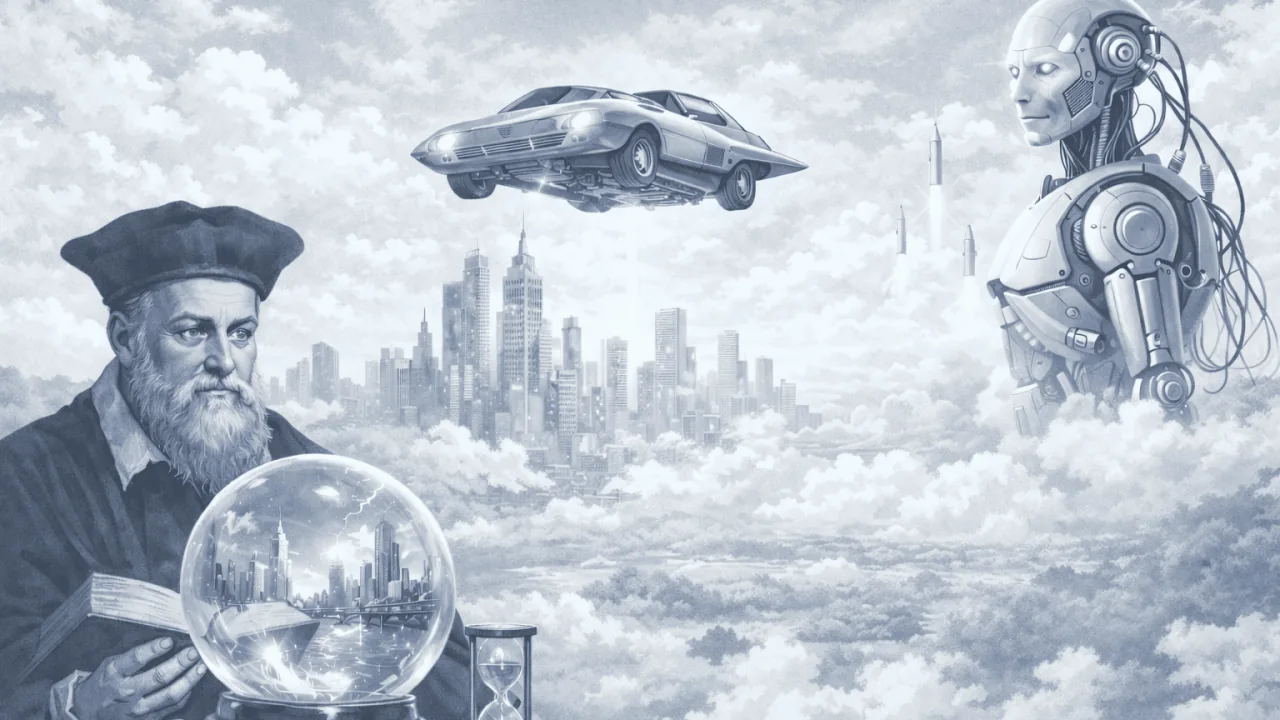
The structural thing is this. Prophecy, as a discipline, selects for survival over accuracy. The prophets who endure across centuries are the ones whose language is flexible enough to outlive the specifics of their own era. Nostradamus is the obvious example. Read the quatrains. They are beautiful, ominous, and almost entirely content-free.
A great leader will rise from the east. A city will fall. Fire will come from the sky. You can fit these predictions to almost any decade of human history, and people reliably do. Every generation finds itself inside the prophecy, because the prophecy was written to accommodate every generation. The great leader rising from the east could be China's next supreme leader. It could also be Schalk Bezuidenhout from Kempton Park.
Every generation finds itself inside the prophecy, because the prophecy was written to accommodate every generation.
The book of Revelations works the same way. It has been imminent for roughly nineteen hundred years. Its staying power comes not from the accuracy of its predictions but from the archetypal texture of them. Horsemen. Seals. A great beast. You can graph these onto Napoleon, Hitler, the Soviet Union, the European Union, the internet, climate change, and artificial intelligence, and people have done all of these in earnest. The text is not predictive. The text is a mirror with ominous lighting. There is, if you squint, a hierarchy of prediction survival, and accuracy is not what governs it.
At the top sits the vague and the archetypal. Nostradamus. Revelations. The Oracle at Delphi, who famously told Croesus that if he attacked Persia he would destroy a great empire, which turned out to be his own. This tier is effectively unfalsifiable and consequently immortal. Below it, the specific and correct, which we retroactively crown as vision. Arthur C. Clarke on communication satellites. Vannevar Bush on the Memex. Alan Kay on the Dynabook. These people made testable predictions that happened to land, and we remember them for it, sometimes with more credit than the prediction deserved. Below that, the specific and wrong, which we quietly bury. Nobody reads the futurism of 1972 for its batting average. And at the bottom, the specific, wrong, and said confidently on camera, which becomes comedy. The flying car. The paperless office by 1995. The death of television by 2010. The metaverse.
The survivors in the prophecy business are not better forecasters. They are better hedgers. This is not an accusation. It is an observation about what the medium rewards.
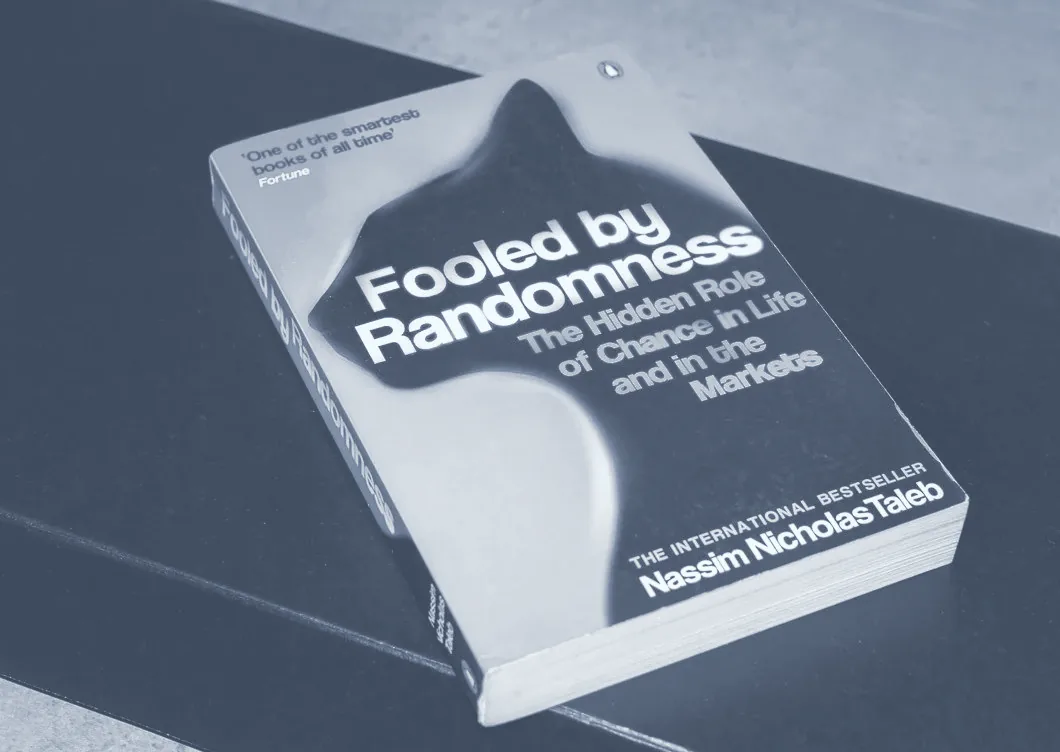
Fooled by Randomness
Nassim Taleb tells a story in Fooled by Randomness that has stayed with me for years, and which I think about every time someone writes me an article with a confident timeline on it or publicly states that x stock will be at y price by next week.
Imagine a man who plays Russian roulette for a living. One chamber loaded, five empty. Every time he pulls the trigger and survives, he is paid ten million dollars. He does this, suppose, nine times. He is now ninety million dollars richer. He appears on magazine covers. His children attend good schools. He is invited to give talks. When asked about his success, he speaks with the measured confidence of a man who has clearly figured something out.
Taleb's point is that this man is not successful. He is alive. These are different things, and the culture around him is not equipped to tell the difference. The outcome looks identical to genuine achievement. The bank account looks identical. The confidence looks identical. The only thing that distinguishes the gambler from the genius is the hidden sixth chamber, which you cannot see by looking at the winners, because by definition the people holding it no longer exist to interview.
Taleb called this the problem of alternative histories. Most of what we treat as skill is a single path drawn through a forest of branching outcomes, and we only ever see the branch that got walked. The prophets and the forecasters and the magazine covers are drawn overwhelmingly from the surviving branches, and the graveyard of equally confident people who happened to find the loaded chamber is silent and therefore invisible.
We are retrospective pattern-finders, which means we do this automatically and without noticing. We remember the prophet who called three things right and forget the thirty-seven they called wrong. We remember the fund manager who beat the market for four years in a row and do not notice that in a population of ten thousand fund managers, several will do this by coincidence alone, and will then write books about their method. We remember the founder who bet the company and won, and we do not hear from the hundred founders who made the same bet and lost, because losing founders do not get book deals. Prediction, unexamined, is a survivorship bias machine, and the confident voice that dominates one decade is usually someone who got lucky in the previous one, holding a revolver and smiling.
The unsettling part, and the part I find myself returning to, is that the gambler in Taleb's story is not lying. He genuinely believes he has a method. From the inside, nine successful pulls of the trigger feels exactly like expertise. The human brain is not wired to distinguish between the two, and neither is the marketplace of ideas that decides whose voice we amplify. The confident voice of the next decade is, statistically, already among us, making specific claims we will not be able to evaluate until it is too late to care, and they are almost certainly not aware of the chamber.
All of which would be a tidy theoretical point if we had not, in the last ten years, built something that tests it directly.

The Rise of Prediction Markets
Prediction markets are the structural opposite of prophecy. On Polymarket, on Kalshi, on Metaculus, the resolution criteria are locked before the event. You cannot reinterpret a contract after the fact. You cannot claim you meant something else. A contract that asks whether a particular person will hold a particular office on a particular date will pay out, or not, on that date, and no amount of rhetoric will change it. Philip Tetlock's forecasting tournaments work the same way. Participants commit to probability estimates. They update them over time. The scoring is mathematical. There is no hedge.
What these systems have demonstrated is that most confident forecasters are bad, that the crowd usually beats the individual, and that the people who forecast well share a specific cluster of traits. Tetlock's superforecasters are not visionaries. They are calibrators. They update frequently. They carry no ideology. They are specific about what they mean and careful about the range of outcomes they commit to. They almost never make the kind of declarative single-scenario prediction that a speaker circuit would pay for. A superforecaster will tell you there is a 63% probability of event X occurring within an 18-month window and will revise that estimate publicly six weeks later. This is a terrible story. Nobody builds a brand around it.
The prophets, meanwhile, go on television.
We have therefore built, at real infrastructural cost, a mechanism that proves human prophetic confidence is usually unwarranted, and we have mostly chosen to ignore what it tells us. The markets move billions through these contracts and the op-ed pages run, in parallel, the next confident declaration about what will be true in 2030. The cognitive dissonance is not even particularly well hidden. It is simply that the market is boring and the declaration is interesting, and attention follows interest rather than evidence.
Which brings us, at last, to the prophecy currently eating the oxygen in the room. And I thank you for walking this far with me.
The AI discourse of the last three years has developed the full grammar of confident prediction. AGI by a specific year. Labour replacement at a specific rate. Extinction risk at a specific percentage. Liberation from toil on a specific timeline. Graphs with hockey-stick curves pointing confidently at a date some comfortable distance in the future, far enough out that nobody making the prediction will have to answer for it in their current role, and close enough that you can feel the urgency now. The tone is familiar. It is the tone of Beyond 2000, with higher production values and a LinkedIn following.
I want to be careful here, because the easy article to write is the one that sneers at everyone making these predictions and walks away feeling superior. That is not the article I am trying to write. Some of what these voices are saying will land. Some of what Beyond 2000 said landed. The internet did reshape everything. The mobile device did become the main computing interface. Physical media did collapse. There were people in 1987 who saw those shapes correctly, and the fact that they wrapped their correct intuitions in incorrect specifics does not mean we should discard the intuitions. It means we should be honest about which part is the signal and which part is the texture.
The problem is not that prediction is happening. The problem is that the predictions are being made in a register that looks specific and functions as a hedge. A claim like "AGI by 2027" sounds precise. It is not. The term AGI has no agreed definition, the goalposts have moved four times in the last decade, and anyone making the claim has a small library of fallback positions available if 2027 arrives without the predicted event. "We meant weak AGI." "We meant certain cognitive tasks." "Progress was faster than expected in some areas and slower in others, which was itself the prediction." The specificity is cosmetic. The structure is prophetic.
You can run the same audit on the other direction. Extinction in ten years. Replacement of all knowledge work in five. Superintelligence in eighteen months. These claims are in the same grammatical family as a great leader rising in the east. They are specific enough to feel credible, vague enough to survive being wrong, and timed just far enough out that accountability belongs to someone else.
Lessons Learnt
What I have learned in thirty-three years of watching these cycles is that the people who end up being right about technology are rarely the ones on stage during the peak of the prophecy phase. They are the ones doing the unglamorous work of building specific things and describing those specific things accurately. They tend to be cautious about the adjacent claims, because they have enough texture on their own domain to know how wrong you can be about something you understand well, and how much more wrong you will be about something you do not.
The confident voice, historically, is almost never the one worth following. The voice worth following is the one that can tell you, in careful detail, what it knows, what it does not, and what evidence would change its mind. That voice is rarely trending. It is rarely making the keynote. It is rarely on the panel. It is, instead, somewhere a few layers underneath the discourse, building things, and you must go looking for it.
Which does not mean you should ignore the prophecy entirely. The prophecy is telling you something, just not about the future. It is telling you what the culture is anxious about, what it is hopeful for, and what it is willing to pay to be told. The prophecy is a reading of the present, dressed up as a reading of the future, and taken that way it is informative.
The AI prophecy of 2026 tells you that we are collectively unsure what knowledge work is worth, that we have lost confidence in our own cognitive uniqueness, and that we are both exhilarated and frightened by the speed of our own tools. These are real things. They deserve real attention. They just do not deserve the specific timelines being attached to them.
Beyond 2000 closed each episode with a little sting. A reminder that the future was coming, and it would be amazing, and all you had to do was tune in next week. I was ten years old when I first saw an episode, and I believed it completely. I still, in some ways, believe it. The future did come. It was amazing. It was not the one they described, and the one they described would probably have been worse, because a future designed by people who are certain about the future is almost always narrower than the one that arrives.
The flying car never showed up. The world they were gesturing at, though, the interconnected one, the mediated one, the accelerated one, absolutely did. They were right about the shape and wrong about the specifics, which is, it turns out, the best any honest forecaster can manage. The prophets who survived them did not do better. They just learned not to mention the flying car.
I would like, for what it is worth, to live in a world where we honour the former and not the latter. Where being specific and partially wrong is treated as more useful than being archetypal and unfalsifiable. Where Beyond 2000's flying car is remembered with affection rather than mockery, and where the 2026 AGI keynote is treated with the polite scepticism you would extend to a man in a long robe predicting the end of the world in a public square.
We are not there yet. We may never be. But every so often, particularly around the peak of a new prophecy cycle, it helps to remember the shape of the pattern. I was eleven years old with a floppy disk in my pocket when I learned my first lesson about the gap between what a system promises and what it actually does. I have been collecting lessons ever since. None of them have made me better at predicting the future. All of them have made me a little more suspicious of anyone who claims they can.